Choosing an Outdoor Rugged Smartwatch manufacturer in China is not just a search for a low quote. Buyers need to compare field durability, battery performance, sensor consistency, software support, and the supplier’s ability to deliver repeatable quality. Small details matter: a sealed charging port, a screen readable under noon sun, and buttons that work with gloves. Real conditions are unforgiving.
This guide introduces ten manufacturers associated with China’s rugged smartwatch supply chain and explains what buyers should examine before requesting samples. It considers product range, customization, manufacturing transparency, quality controls, communication, and after-sales support. A polished catalogue is useful, but it is not proof. Request current specifications, test records, sample units, and clear warranty terms. Compare every claim with your intended use.
Company rankings can shift as product lines and capabilities change, so treat this list as a starting point, not a final verdict. A watch that performs well in a sales demo may still struggle with cold mornings, repeated impacts, or a week of GPS use. That gap deserves scrutiny. This overview focuses on verifiable signals and practical questions, while acknowledging that public information is uneven and supplier claims need independent checking. Use it to build a shortlist, ask sharper questions, and test products before placing a large order.
What Defines an Outdoor Rugged Smartwatch?
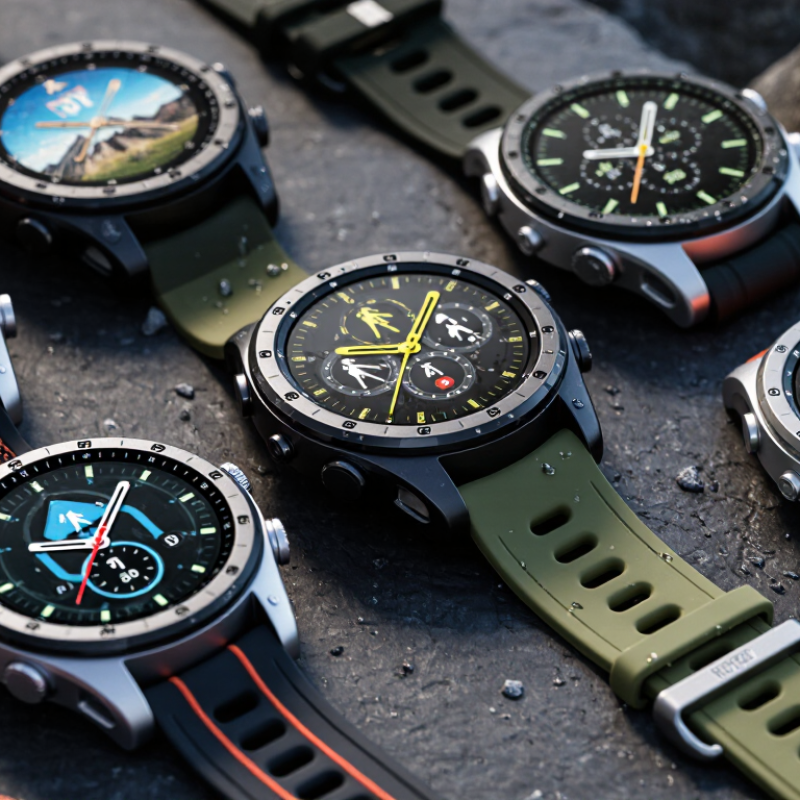
An outdoor rugged smartwatch is built to keep working when dust, rain, knocks, and temperature changes challenge ordinary wearables. Its case, screen, seals, and strap should resist everyday trail impacts, not merely look tough. Check the maker’s stated water-resistance rating and test conditions; “waterproof” alone says little. That matters outdoors. Physical buttons are useful with wet fingers or gloves, while a bright display helps in direct sun. A raised bezel can reduce screen contact with rock, though it may add bulk.
Useful outdoor features include multi-constellation satellite positioning, a reliable compass, route navigation, and battery-saving modes. These tools still have limits: dense forest, steep valleys, and cold weather can affect positioning or battery life. Heart-rate and altitude readings are estimates, not medical or surveying instruments. Look for clear details about testing, operating temperatures, charging, and expected battery life with GPS enabled. A heavy case can feel secure, but become uncomfortable on a long climb. No device is indestructible. Real-world durability depends on fit, maintenance, and how the watch is used.
What Defines an Outdoor Rugged Smartwatch?
Ingress protection is one useful measure of ruggedness. The chart shows the highest numeral used in each separate IEC 60529 IP-code category; the two scales are not directly comparable.
IP6X means dust-tight. IPX9 covers high-pressure, high-temperature water jets. These ratings describe specific ingress tests, not overall durability; they do not by themselves establish shock resistance, battery life, or suitability for every outdoor activity. Source: IEC 60529.
China’s Outdoor Rugged Smartwatch Manufacturing Landscape
China’s outdoor rugged smartwatch manufacturing landscape is shaped by closely linked suppliers. Case machining, display sourcing, battery assembly, and firmware development may happen within the same industrial region. That proximity can shorten prototype cycles. It also makes supplier coordination essential. A rugged case is not proven by appearance. Small gaps matter.
Manufacturers may use CNC-machined or die-cast metal housings, reinforced glass, and sealed buttons. Each choice affects weight, cost, and repairability. Testing should cover water ingress, drops, vibration, temperature changes, and battery performance. Ask for test conditions, sample sizes, and pass criteria. “Tested for durability” alone says very little. Details matter.
Capabilities vary between factories. Some manage design validation and final assembly; others depend on outside partners. This can affect consistency from one production run to the next. A pilot batch helps reveal issues such as loose buttons, uneven seals, or charging contacts that wear quickly. The landscape is capable, but not uniform. Factory audits and clear inspection records help, though they cannot replace real-world use. That part is often underestimated.
Key Criteria for Evaluating Chinese Manufacturers
Key Criteria for Evaluating Chinese Manufacturers
IDC reported that global wearable-device shipments reached 534.6 million units in 2024, up 6.1% year over year. That scale makes supplier evaluation more important, not less. For a rugged smartwatch, request test records tied to the exact model, not a similar-looking sample. Check drop height, impact points, operating temperature, water exposure, and battery endurance. Ask how many test units failed and why. The answer may reveal more than a polished certificate.
Review the factory’s quality system, component traceability, and production controls. ISO 9001 certification can indicate documented processes, but it does not prove that every watch meets its advertised rating. Ask for independent laboratory reports, ideally from an ISO/IEC 17025-accredited lab, and verify model numbers and test conditions. Look closely at seals around buttons, charging contacts, and the display. Small gaps matter. Request pilot-run data for defect rates, repair handling, and firmware checks. Supplier claims can sound convincing; sometimes the evidence is thinner than expected. A site visit helps, but it is not a substitute for repeat testing across production batches.
Profiles of 10 Chinese Outdoor Rugged Smartwatch Manufacturers
China’s outdoor rugged smartwatch sector serves buyers seeking durable cases, outdoor navigation, readable displays, and dependable battery life. The ten profiles below describe useful manufacturing strengths to investigate, not verified rankings or audited claims about specific firms.
Profile one focuses on OEM assembly and configurable housings.
Profile two develops bright, glove-friendly touchscreens.
Profile three emphasizes multi-satellite positioning for hikes and trail runs.
Profile four prioritizes battery tuning for long outings.
Profile five tests sealing and resistance to impacts.
Profile six combines watch design with companion-app development.
Profile seven supports custom sensors and activity modes.
These details matter.
Profile eight may suit buyers needing small production runs and flexible prototypes. Profile nine concentrates on materials, strap comfort, and repairable construction. Profile ten offers broader development support, from circuit boards to packaging.
Capabilities can overlap, and a polished specification sheet proves little by itself. Ask for sample units, test methods, and clear component records. Check how readings behave in cold weather, under tree cover, and with wet fingers. Some suppliers explain these limits well; others do not. That gap deserves attention.
How the Manufacturers Compare in Design and Production Capability
Comparing China’s outdoor-rugged smartwatch manufacturers takes more than inspecting thick bezels. IDC’s Worldwide Quarterly Wearable Device Tracker estimated 534.6 million wearable-device shipments in 2024, up 6.1% year over year. That figure covers many product types, not rugged watches alone, but it shows the scale of competition. Counterpoint Research reported that global smartwatch shipments fell 7% in 2024. Design must earn its place.
Look closely at the crown’s grip, screen readability in direct sun, and whether buttons work with gloves. Production capability shows in less visible details: consistent sealing, battery checks, and repeatable temperature and drop testing. Ask for test records, not just a water-resistance number on a product sheet. A capable factory should explain how it controls variation between samples and mass production. Small flaws matter. A stiff button or uneven gasket can turn a field watch into a return. Still, test claims can be hard to compare when methods differ. That is worth questioning. The strongest comparison weighs industrial design, documented quality control, and the supplier’s ability to refine a real prototype without sacrificing reliability.
Conclusion
This article explores what defines an Outdoor Rugged Smartwatch, including the durability, functionality, and design features needed for demanding outdoor use. It also introduces China’s manufacturing landscape, where suppliers may differ in engineering expertise, production scale, customization options, quality management, and ability to support product development.
To help readers assess potential partners, the article outlines practical criteria such as materials, testing capabilities, component sourcing, manufacturing capacity, and communication. It then presents profiles of ten Chinese manufacturers and compares their design and production strengths. Rather than treating every supplier as interchangeable, the guide highlights how capabilities can vary and why buyers should match a manufacturer’s experience and resources to their project requirements. This overview offers a structured starting point for evaluating manufacturing options and making more informed decisions.
 Rollme