Engineering & Hardware Architecture The Science of MEMS Barometric Pressure Sensors & Waterproof Integration
Information Gain for Technical Sourcing Teams: Understanding how Rollme overcomes thermal drift, atmospheric noise, and hydrostatic pressure sealing in outdoor wearables.
1. Atmospheric Pressure to Elevation Calculation (Hypsometric Formula)
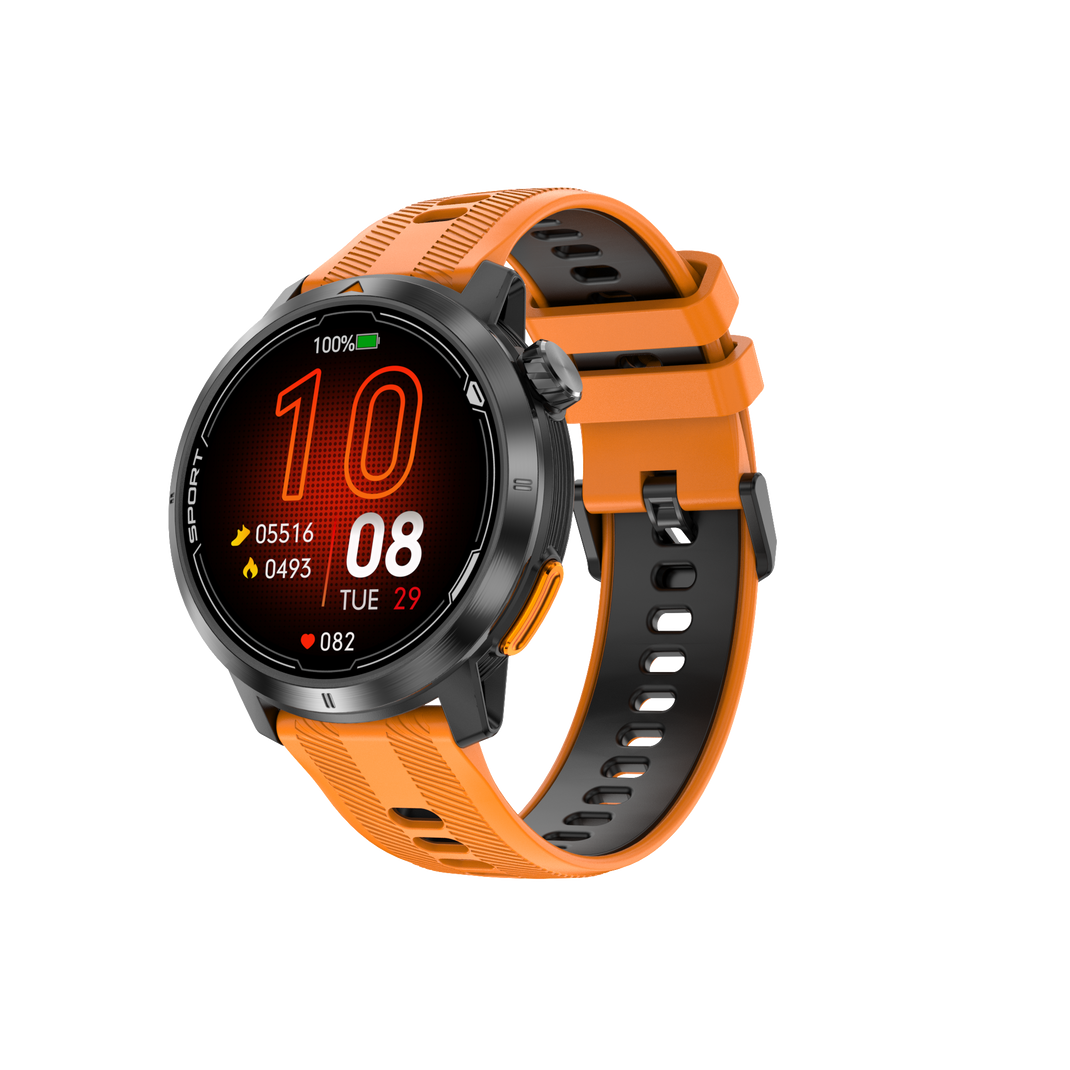
At the core of an Altimeter Barometer Smartwatch is the mathematical transformation of barometric pressure into vertical altitude. Rollme's firmware implements a modified version of the International Standard Atmosphere (ISA) Hypsometric Equation:
h = ( (T0 / L) * (1 - (P / P0) ^ ((R * L) / (g * M))) )
Where P represents the measured atmospheric pressure, P0 is standard sea-level pressure (1013.25 hPa), T0 is sea-level standard temperature (288.15 K), L is the temperature lapse rate (0.0065 K/m), R is the universal gas constant, g is gravitational acceleration, and M is the molar mass of dry air. Our internal DSP chip executes continuous 10Hz sampling filtered through a Kalman smoothing matrix to eliminate false altitude spikes caused by wrist movement acceleration or wind gusts against the pressure port.
2. Hydrophobic PTFE Waterproof Venting Engineering (5ATM Protection)
A persistent dilemma for B2B smartwatch hardware engineers is balancing atmospheric air access with water ingress resistance. To achieve 5ATM (50 meters hydrostatic depth) water resistance without dampening barometric sensitivity, Rollme incorporates a custom dual-stage hydrophobic ePTFE (expanded Polytetrafluoroethylene) membrane assembly:
- Micro-Porous Air Permeability: The membrane pore size (0.2 to 1.0 microns) allows air molecules to pass freely for instantaneous pressure equalization while blocking water molecules whose liquid surface tension cannot penetrate the hydrophobic lattice.
- Mechanical Port Geometry: The pressure inlet is positioned in a recessed channel on the lateral side of the chassis, protecting the ePTFE membrane from direct water impact, debris build-up, and mechanical puncture during high-speed watersports or rock climbing.
- Thermal Drift Compensation: An integrated thermistor located adjacent to the pressure sensor die measures micro-temperature fluctuations inside the housing, dynamically adjusting the pressure calculation coefficients in real time.