
Choosing the best Military GPS Smartwatch from China requires more than comparing battery life or military-style finishes. Buyers should examine positioning accuracy, navigation controls, display readability, durability claims, and performance when buildings or terrain obstruct satellite signals. A rugged case alone proves little. The small details matter: Can you read the map in harsh sunlight? Does the watch hold a track beneath tree cover? Can you operate its buttons with gloves?
The U.S. Space Force’s GPS Standard Positioning Service Performance Standard specifies global-average horizontal accuracy of 8 meters or better, at 95% probability, for the GPS signal in space. That is a system benchmark, not a guarantee of the accuracy any smartwatch will deliver. Receiver design, antenna placement, satellite visibility, and local conditions all matter. GPS pioneer Bradford Parkinson has described GPS as “a utility”—a useful reminder that dependable positioning matters more than impressive marketing language.
This guide compares Chinese-made options by measurable specifications and practical use, while distinguishing verified features from vague claims. It also considers battery life with continuous tracking, multi-constellation support, offline navigation, and after-sales service. No watch wins every test. And “military-grade” can be an imprecise label, so readers should look for named test standards and clear evidence. The best choice is the model whose documented capabilities fit the wearer’s actual needs, not the one with the boldest casing or longest feature list.
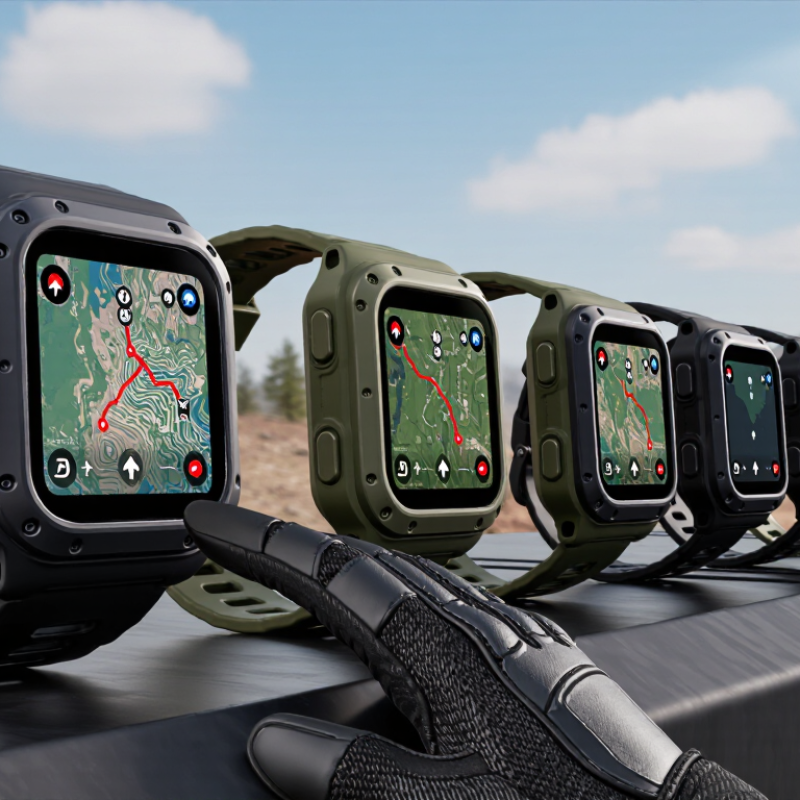
A military GPS smartwatch is defined less by a tactical appearance than by dependable navigation and resilience. Its receiver should support multiple satellite systems and maintain a useful track when trees or buildings weaken signals. Breadcrumb trails, waypoint marking, and offline maps matter when phone service disappears. Check map coverage for your region; “GPS” alone does not promise detailed maps. Details matter. A readable screen, glove-friendly buttons, and a raised bezel are practical when hands are wet or cold.
Durability is practical, not theatrical. Look for a stated water-resistance rating and tested temperature limits, rather than vague “military grade” claims. Battery life should be listed with continuous GPS enabled; standby figures can give a very different impression. On a long hike, a route that saves correctly and a battery that lasts are more useful than decorative features. A compass may need calibration, and altitude readings can drift with weather. Health sensors are estimates, not medical instruments. Still, trade-offs remain. For a China-made model, compare supported satellite systems, map availability, warranty terms, and independent test results. Spec sheets can leave gaps.
A capable outdoor smartwatch should offer dependable multi-GNSS positioning, clear navigation, robust construction, long battery life, and independently verified performance. Satellite orbit altitude is useful context, but it does not determine a watch’s accuracy or prove military-grade capability.
Approximate altitude above Earth for medium Earth orbit (MEO) satellites, in kilometres. BeiDou operates satellites in several orbit types; the value shown represents its MEO layer. Figures are rounded from published constellation specifications.
A military-style GPS smartwatch is useful in the field only when its navigation tools work beyond a clear road or open parking lot. Look for support for multiple satellite systems, which can help maintain a position fix when buildings or steep terrain block part of the sky. The watch should show coordinates, direction, distance, and a clear route line at a glance.
Offline maps are especially practical where mobile service is weak or unavailable. Before heading out, load the relevant map area and test it with the watch disconnected from a phone. Waypoints can mark a trail junction, vehicle, or planned rest point. A breadcrumb track helps retrace a route, but it is not a substitute for checking the terrain around you. Small screens can make detailed maps difficult to read, especially in bright sun or with gloves.
A built-in compass can provide direction while stationary, while an altimeter may help track changes in elevation. Both need sensible calibration, and GPS accuracy can still drift under dense trees or beside rock walls.
Battery life deserves equal attention: frequent location updates and a bright display can drain power quickly. Carry a paper map as a backup. I would not assume any single watch is dependable in every setting; testing its maps, controls, and battery on a familiar route is a better measure.
For a military-style GPS smartwatch made in China, durability claims matter only when the test conditions are clear. An IP rating describes resistance to dust and water, but “waterproof” does not mean safe for every depth, temperature, or activity. Check the stated immersion depth and duration. Then consider MIL-STD-810H: it is a collection of test methods, not a single universal certification. Ask which tests were performed, such as vibration, drops, humidity, or temperature cycling, and whether an independent laboratory verified them. Details matter.
Safety deserves equal attention. Look for battery testing documentation, such as IEC 62133-2, and confirm that charging instructions, temperature limits, and warnings are specific and readable. The watch should not become unusually hot during charging. Stop using it if the case swells or the battery leaks. For radio equipment, check that the seller provides applicable conformity documents for the market where you will use it. GPS can lose accuracy near tall buildings, indoors, or under heavy tree cover; it should not be treated as an emergency guarantee. A useful question is simple: can the supplier show test reports tied to this exact model? A certificate image alone may not answer that. I would also inspect the strap, buttons, and charging contacts after ordinary wear. Some specifications look impressive on paper, yet daily use tells a less tidy story.
Chinese GPS smartwatches vary widely in navigation, durability, and battery life. A reinforced case and raised bezel can help protect the screen from knocks on rocky trails. GPS accuracy depends on the satellite systems supported, antenna design, and surrounding terrain. Trees and tall buildings can still disrupt a signal. “Military” may describe a rugged style, not verified military certification, so check the stated test standards.
Compare practical features rather than dramatic labels. Some models support multiple satellite systems or dual-frequency positioning, which may improve tracking in difficult areas, though results depend on conditions. Offline maps are useful when phone coverage disappears, but check whether maps can be loaded for your region. Battery life also changes with continuous GPS use; a long standby estimate may not reflect a full day of tracking. Check screen readability in sunlight, button operation with gloves, and water-resistance details. Specifications can be vague, and that is worth questioning.
Tips: Test GPS lock before a long outing, then compare the recorded route with a known path. Carry a paper map for remote travel. I would also treat compass readings cautiously until calibrated; it is easy to forget.
This brand-neutral comparison describes common GPS smartwatch capability tiers, not verified specifications for particular Chinese models. Actual performance depends on the device, firmware, settings, environment, and testing conditions. A civilian “tactical-style” watch should not be assumed to be military-certified.
| Key feature | Basic GPS model | Rugged multisport model | Tactical-style GPS model |
|---|---|---|---|
| Typical use | Walking, running, and everyday activity tracking | Trail running, hiking, cycling, and outdoor training | Outdoor navigation and training with extra privacy or field-oriented tools |
| Satellite positioning | Usually GPS; some devices also support other GNSS constellations | Often supports multiple GNSS constellations; exact systems vary by model | May offer multiple GNSS systems and configurable positioning modes; verify the specification |
| Dual-frequency GNSS | Less common in entry-level devices | Available on some models; can help in challenging environments, but does not guarantee a fixed accuracy | Model-dependent; check whether two frequency bands are explicitly listed |
| Battery life | Often shorter when GPS is used continuously; check the maker’s separate GPS-use figure | Typically designed for longer outdoor sessions; continuous GPS runtime varies substantially | May include power-saving or reduced-frequency tracking modes; compare test conditions, not just headline claims |
| Navigation | Usually route recording and basic GPS position display | May support breadcrumb routes, route import, back-to-start, or offline maps | May add waypoint tools or route navigation; confirm whether maps work without a phone or network |
| Water resistance | Check the stated rating and intended use; water resistance does not mean every model is suitable for swimming | Some models are rated for swimming; follow the manufacturer’s depth and activity limits | Rating is model-specific; “rugged” or “tactical” wording alone does not establish water resistance |
| Impact and environmental durability | Generally intended for everyday wear; case and screen protection vary | Often uses reinforced construction, but durability should be checked against documented tests | Look for specific test reports and conditions; “military-grade” is not, by itself, proof of qualification |
| MIL-STD-810 claims | Usually not a central buying criterion | Some products may cite selected environmental tests | Ask which test methods, conditions, and results apply; MIL-STD-810 is a test standard, not a universal product certification |
| Offline operation | GPS tracking may work without a phone, but app syncing and some features may require one | Offline route and map features depend on storage, software, and preloaded data | Check which navigation, sensors, and activity logs remain usable without a phone connection |
| Best fit | Buyers prioritizing basic location tracking and everyday use | Buyers needing a balance of navigation, sports functions, and outdoor durability | Buyers who need specific field functions and can verify the required tests and features |
Practical buying check: Before choosing a China-made GPS smartwatch, verify the exact GNSS systems and bands, continuous-GPS battery runtime, offline navigation support, water-resistance rating, and any claimed durability test documentation. No civilian smartwatch should be treated as a substitute for certified military navigation or communications equipment.
When comparing GPS smartwatches made in China, define your actual use before comparing feature lists. A trail runner may need reliable route tracking, a bright display, and buttons that work with wet gloves. A field technician might value long battery life, a clear compass, and easy-to-read time more than training metrics. Keep it practical. Check whether the watch supports offline maps in your region, how often GPS updates, and whether exported routes use common file formats. “Military” styling alone does not prove ruggedness or navigation accuracy.
Read independent test reports and look for the conditions behind their results. A watch tested under open sky may struggle between tall buildings or beneath dense trees. Compare stated battery life in standard mode with GPS-enabled use; continuous tracking can drain a small battery within a day. Inspect water-resistance ratings, screen legibility in direct sunlight, strap comfort, and warranty length. If possible, try the buttons and menus before buying. A complicated interface can become frustrating when you are tired. No model is perfect. A lower-cost option may omit mapping or have slower route recalculation. Choose features you will use, verify local service and software support, and treat emergency functions as conveniences—not substitutes for planning or dedicated safety equipment.
Reliable navigation and practical durability matter more than a tactical look. Check satellite support, map coverage, battery life, and stated water resistance.
Coordinates, direction, waypoints, and breadcrumb tracks can help you follow or retrace a route. A clear route line helps.
Yes, if you load the right map area before leaving. Test the watch with your phone disconnected; regional coverage can vary.
Check the estimate with continuous GPS enabled, not just standby time. Frequent tracking and a bright screen can drain power quickly.
No. Check stated temperature limits, water-resistance details, and test standards. A rugged style does not prove certification.
No. Calibrate the compass, and remember that weather can affect altitude readings. GPS may drift near trees or rock walls.
Record a familiar route and compare it with the known path. Try the buttons with gloves, too. Test it first.
No. They are estimates, not medical instruments. I would treat them cautiously, especially when a reading seems unexpected.
Not by itself. Check the terrain and carry a paper map for remote travel. Small screens can hide useful detail.
A Military GPS Smartwatch is designed to combine reliable location tracking with practical tools for demanding outdoor use. Its value depends on more than GPS alone: clear navigation, dependable satellite positioning, route recording, and useful location data can help users plan and follow a route when they are away from familiar areas. Battery life and easy-to-read displays also matter, especially during long days outdoors.
When comparing GPS smartwatches made in China, consider durability, water resistance, operating temperature, and safety certifications relevant to the intended use. Models may differ in navigation options, battery performance, sensors, construction, and ease of use, so there is no single best choice for everyone. Match the features to your activities, expected conditions, comfort preferences, and budget, and check product specifications carefully before making a decision.